 Nocturne Gallery
Why Was William Etty’s Nude Painting Called Immoral? The Sirens and Ulysses (1837)
William Etty (1787–1849) was accused of immorality because he kept painting the nude. His biographer Gilchrist reports that for The Sirens and Ulysses (1837) Etty said viewers had missed its moral, “The Wages of Sin is Death.” The picture came back unsold. Most of Etty’s own words reach us through that one admiring biographer.
The accusation, in Etty’s own telling
Etty was born in York on 10 March 1787 and was elected a Royal Academician in 1828.3 Almost everything we know about how he answered his critics comes from Alexander Gilchrist’s Life of William Etty (1855), a biography by an admirer.2 We therefore give his statements about Etty’s character and motives as Gilchrist’s, not as established fact.
Gilchrist writes that people who knew Etty “only in his Works” formed wrong conclusions and accused him, “as he says,” of being “a shocking and immoral man.”2 He also quotes Etty: “People may think me lascivious,” Etty would protest, “but I have never painted with a lascivious motive. If I had, I might have made great wealth.”2 Gilchrist adds that Etty’s Autobiography contained the declaration that “if in any of my pictures an immoral sentiment has been aimed at, I consent it should be burnt.” We have not opened the Autobiography and know the sentence only through Gilchrist.2
“There is nothing indecent in my Pictures,” Gilchrist says Etty “was wont to insist,” “only in the vile notions people may bring with them.” This is a habitual remark, not a dated one.2 Six years after Etty’s death, Gilchrist put the argument in his own words: “The indecency, if it exist, is in their eyes and hearts.”2
From a printer’s shop to the life school
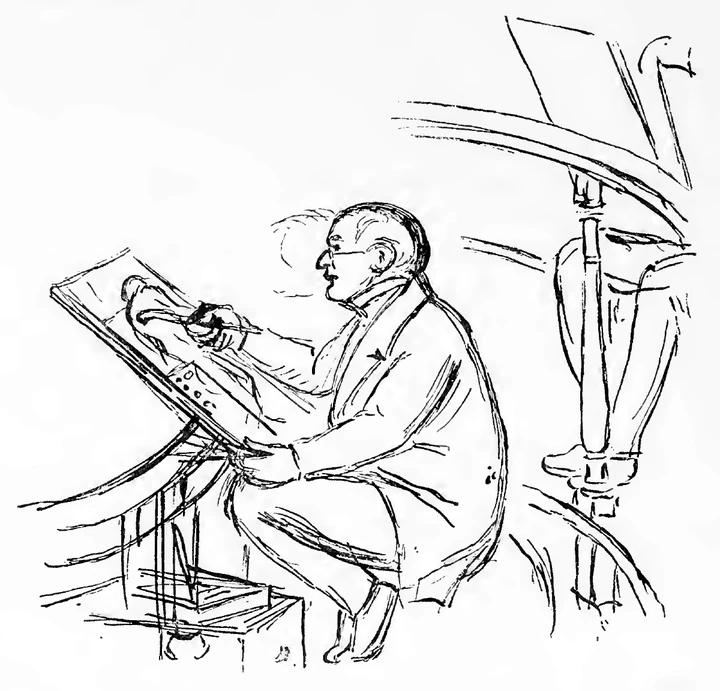
Etty was apprenticed in October 1798, at eleven and a half, to a printer in Hull. The apprenticeship ended on 23 October 1805.1 He then went to London, where an uncle in a gold-lace firm let him come for a trial, and paid the portraitist Thomas Lawrence a hundred guineas in 1807 for lessons Lawrence had little time to give.1 Gilchrist records the Academy porter’s usual report on his submissions: “Four out, Sir, and two doubtful!”1
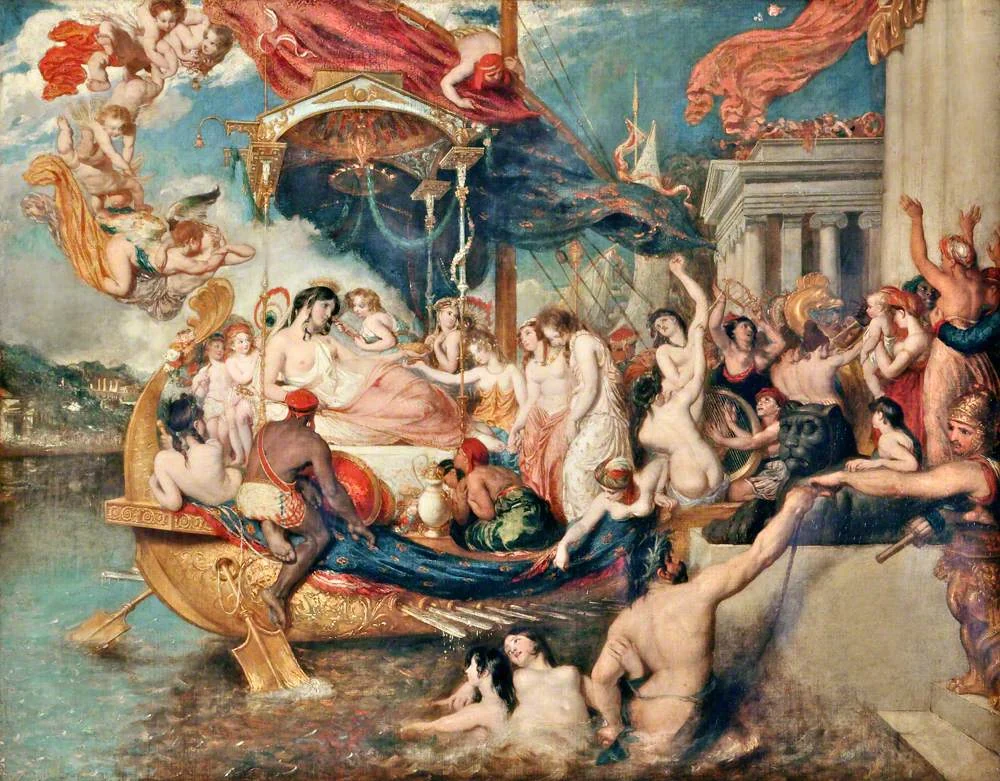
The Dictionary of National Biography says his fellow students saw a worthy, plodding person with no chance of becoming a good painter, and that Etty himself said he found woman to be “God’s most glorious work.” It also says he attended the Academy’s life school, where students draw from a nude model, almost every evening until illness stopped him in 1848.3 His Cleopatra’s Arrival in Cilicia was shown at the Academy in 1821.3

What the friendly sources say about the man
Gilchrist calls Etty’s life “singularly and uniformly continent.”2 The Spectator’s reviewer of Gilchrist’s book in 1855 says it was “more than commonly free from what is specially understood by ‘immorality.’” The same reviewer calls him set in his habits and says that in 1837 he opposed his niece’s marriage, largely because it would have disrupted his routine. That episode comes through Gilchrist and we have not checked it elsewhere.4
In York, Etty opposed the redesign of the Minster’s interior after the fire of 1829, and later campaigned for the city walls.49 Both sources are friendly to him, and neither is a neutral court on his private life. They record what his admirers claimed, and nothing in them contradicts it.
1837: The Sirens and Ulysses
Etty began the picture on 14 November 1836 and showed it at the Royal Academy’s first exhibition in its new building on Trafalgar Square, which opened on 1 May 1837.2 Gilchrist gives its size as about 14 ft 6 in by about 10 ft, with twenty figures; the University of York gives 297 × 442.5 cm. These are the same dimensions: 442.5 cm is about 174 in, or 14.5 ft.27 For the dead sailors Etty visited charnel-houses and studied bodies at every stage of decay, according to Gilchrist.2
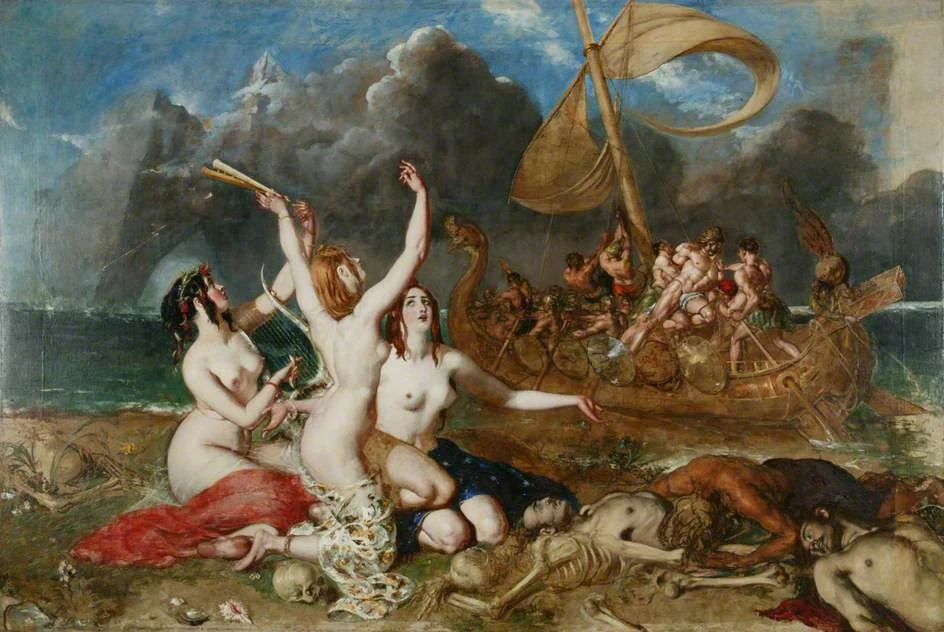
Gilchrist reports how the public reacted. Fast young men, pointing to a bare-bosomed Siren, would exclaim “How disgusting!” Ladies “could scarcely be persuaded to turn their heads” toward it. One critic asked, “Who would like to have the representation of a charnel-house in his apartments?” Gilchrist also quotes a judge he identifies as the Spectator: “Glowing in colour, wonderful in execution, but conceived in the worst possible taste.” We have not seen the Spectator’s own issue, so this wording is Gilchrist’s report of it.2
Etty’s reply, again as Gilchrist gives it: “If they had understood the moral,” the painter remarked, “they would have felt differently.” The moral was “The Wages of Sin is Death.” A clergyman friend thought the text might have been written under the picture, so as to “arrest attention to its real aim.”2 The Sirens and the Delilah came back to the studio unsold.2
Later that year, in Manchester, over wine at dinner, Daniel Grant asked what Etty would take for both pictures. Etty named £300. Grant put down £200 in notes and then another £50, and Etty refused at first, then accepted £250 late that night. Grant had not seen the Sirens. Gilchrist says that by 1854 the money value of the pair considerably exceeded £2,000.2
Joan of Arc, and the end in York
In 1839 Etty planned a series of nine pictures, with a triptych on Joan of Arc as saint, patriot and martyr.5 In October 1846 he gave himself to finishing it, and the set sold for £2,500, says the Dictionary of National Biography.3 The museum in Orléans bought the central panel in 1982 and hung a second panel beside it in 2025. Where the third panel is, we could not establish.56
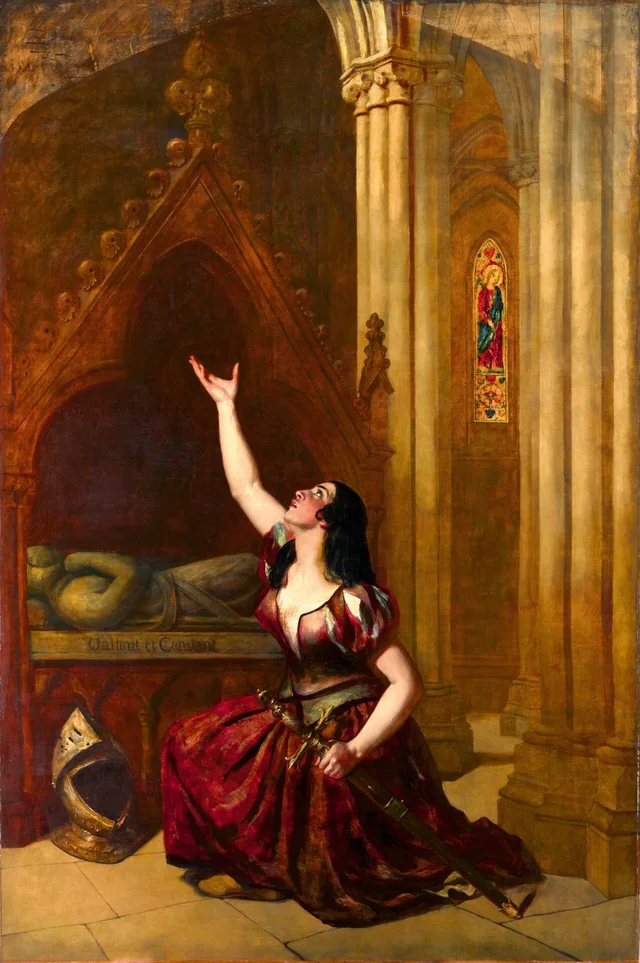
In August 1849 the Society of Arts in London showed a room of his collected works. Etty wrote to his brother Walter on 18 August: “It is truly a triumph, after a struggle of many years, to see and feel one’s works duly estimated, considered, and applauded …”2 He died in York on 13 November 1849, at a quarter before eight in the evening. Gilchrist says that a servant was in the room and that Etty told her, pointing to his portrait: “You will have me there.”2
He had asked to be buried near the choir of York Minster. Gilchrist says the Minster asked about £500 in fees, that Etty’s will made no provision, and that nobody offered to waive them. The funeral was public. The mayor and corporation walked, the shops shut, and, as Gilchrist notes, the Royal Academy sent “no mark of respect.” Etty lies in St Olave’s churchyard, before a bricked-up doorway of the ruined abbey church.2
Myth versus fact
- Myth: Etty was an amateur who dabbled in nudes. Fact: By the Dictionary of National Biography’s account he drew from the model at the Academy almost every evening for decades, until illness stopped him in 1848.3
- Myth: The Sirens was an instant commercial success. Fact: By Gilchrist’s account it came back from the Academy unsold and was sold with the Delilah for £250.2
- Myth: Etty never said what his pictures meant. Fact: For the Sirens, Gilchrist reports that he did. We have no second source for the exchange.2
Genuinely uncertain
- The 1822 Times notice. Janes (2011) cites a hostile Times notice of Etty’s nudes from 1822. We have not seen the issue and do not quote it.8
- The Spectator of 6 May 1837. Janes (2011) quotes a harsher wording than the one Gilchrist reports. We have not seen the issue and do not quote it. The Spectator of 20 May 1837 is in the archive, and it does not contain that wording.8
- “He awoke famous.” The Dictionary of National Biography attributes the line to the painter Charles Leslie, and Art UK attributes it to Etty. We do not use it.
- Etty’s Autobiography. We have not opened it. Every quotation from it comes through Gilchrist.2
- Gilchrist’s reliability. He admired Etty. His claims about Etty’s motives and character are his opinion.2
- The grave. Gilchrist reports, on the word of Professor Phillips, that the grave was dug through modern, medieval and Roman layers and that a small earthenware vase was found. We have no second source.2
- Candaules, King of Lydia, Shews His Wife by Stealth to Gyges. We have not confirmed the picture’s date or size from the Tate and do not give either.
Reading, not record
Gilchrist thought that titles from history, Candaules among them, were mostly a pretext for painting the human form.2 Beside that view we put one reading of our own, which is not a finding. In Herodotus’s story of Candaules, a king arranges for another man to watch his wife undress, and the arrangement ends in the king’s death. In the Sirens, the sailors who came to look lie dead. In both stories looking has a price. We do not know whether Etty meant this, and no source we opened says so. For the Sirens we have his stated moral. For Candaules we have only this reading.
Chronology
| Date | Event | Source |
|---|---|---|
| 10 March 1787 | Etty born in York. | 3 |
| 8 Oct 1798 | Apprenticed to a printer in Hull. | 1 |
| 23 Oct 1805 | Apprenticeship ends. | 1 |
| 1807 | Pays Thomas Lawrence a hundred guineas for lessons. | 1 |
| 1821 | Cleopatra’s Arrival in Cilicia shown at the Royal Academy. | 3 |
| 1828 | Elected a Royal Academician. | 3 |
| 14 Nov 1836 | Begins The Sirens and Ulysses. | 2 |
| 1 May 1837 | Royal Academy exhibition opens in its new building on Trafalgar Square. | 2 |
| 1837 | Sirens and Delilah sold to Daniel Grant for £250. | 2 |
| 1839 | Plans a series of nine pictures, including the Joan of Arc triptych. | 5 |
| October 1846 | Gives himself to finishing the triptych. | 3 |
| 1848 | Illness ends his attendance at the life school. | 3 |
| 18 Aug 1849 | Writes to his brother Walter about the Society of Arts exhibition. | 2 |
| 13 Nov 1849 | Dies in York. | 2 |
| 23 Nov 1849 | Public funeral; burial at St Olave’s. | 2 |
| 1982 / 2025 | Orléans buys the central Joan of Arc panel and hangs a second. | 5, 6 |
Frequently asked questions
Why was William Etty accused of immorality?
Because he painted the nude, again and again, in large pictures shown at the Royal Academy. Etty himself said, as Gilchrist reports it, that people who knew him only from his pictures took him for “a shocking and immoral man.” Gilchrist, an admirer, and a Spectator reviewer in 1855 both describe his private life as unusually blameless. We could not open the 1820s and 1830s newspaper attacks themselves.
What did Etty say The Sirens and Ulysses meant?
According to Gilchrist, the painter remarked: “If they had understood the moral, they would have felt differently.” The moral, he said, was “The Wages of Sin is Death.” A clergyman friend thought the text should have been written under the picture. Gilchrist is our only source for this exchange.
How big was The Sirens and Ulysses, and what did it sell for?
Gilchrist gives about 14 ft 6 in by about 10 ft, with twenty figures. The University of York gives 297 × 442.5 cm, which is the same size. It was shown at the Royal Academy in 1837 and came back to Etty’s studio unsold. Later that year the Manchester manufacturer Daniel Grant bought it together with Samson and Delilah for £250, according to Gilchrist.
Where is William Etty buried?
In St Olave’s churchyard in York. He had asked to be buried in York Minster, near the choir. Gilchrist says the Minster wanted about £500 in fees, that Etty’s will made no provision for them, and that no one offered to waive them.
Notes
- Gilchrist, Life of William Etty, vol. 1 (1855), chs. II–III: apprenticeship 8 October 1798 to 23 October 1805; the uncle; Lawrence’s lessons; the porter’s “Four out, Sir, and two doubtful!” Opened 2026-10-29. archive.org/details/lifeofwilliamett01gilc
- Gilchrist, Life of William Etty, vol. 2 (1855), page numbers as in the book. Sirens: ch. XX, pp. 54–55 (charnel-houses), p. 60 (size, twenty figures), p. 62 (Spectator wording), p. 63 (reactions, the moral, unsold), pp. 66–67 (Daniel Grant, £250, value in 1854). Autobiography and sayings: ch. XXX, pp. 317–319 (“shocking and immoral man,” “lascivious motive,” the sentence from the Autobiography), p. 324 (“vile notions”), p. 328 (“eyes and hearts”); “singularly and uniformly continent,” p. 318. Start of the picture on 14 November 1836 and the opening of the exhibition on 1 May 1837: ch. XX (page not recorded in our log). Society of Arts letter, pp. 283–284. Death and “You will have me there,” pp. 296–297. Minster wish and fees, pp. 298–299. Funeral, burial and the grave, pp. 299–300. Checked against a full text of the book supplied to us. Opened 2026-10-30. archive.org/details/lifeofwilliamett02gilc
- Dictionary of National Biography, vol. 18, “Etty, William”: birth date, Academician in 1828, Cleopatra in 1821, “plodding,” “God’s most glorious work,” the life school until 1848, the Joan of Arc sale at £2,500. Opened 2026-10-29. Wikisource
- Spectator, 3 February 1855, review of Gilchrist’s Life of Etty: “more than commonly free from what is specially understood by ‘immorality’”; the niece’s marriage; Etty’s defence of the Minster. Opened 2026-10-29. archive.spectator.co.uk
- Musées d’Orléans, “Un triptyque de légende: William Etty aux Beaux-Arts”: the 1839 plan of nine pictures, the triptych, the 1982 purchase. Opened 2026-10-30. museesorleans.fr
- Musées d’Orléans, “Retour en images sur l’accrochage du tableau de William Etty”: the second panel hung in 2025. Opened 2026-10-30. museesorleans.fr
- University of York, seminar page “A Monster of Beautiful Loathsomeness” (2019): The Sirens and Ulysses, 297 × 442.5 cm. Opened 2026-10-30. yahcs.york.ac.uk. Manchester Art Gallery’s own collection record (accession 1882.3) gives the same size, unframed: 297 × 442.5 cm. Checked 2026-11-03. collections.manchesterartgallery.org
- Janes, Dominic, “William Etty’s Magdalens: Sexual Desire and Spirituality in Early Victorian England,” Visual Culture in Britain 15, no. 3 (2011): 277–305, doi:10.1163/156852911X567824 (secondary; tier 3). The link below is the author’s accepted version, whose page numbers differ from the journal’s. Janes cites the 1822 Times notice as 29 January 1822, p. 3, and the Spectator review as no. 462, 6 May 1837, pp. 426–8. He also cites Etty’s autobiographical statement from the Art Journal of 1849 and from the 1849 Society of Arts catalogue, p. 9. We have seen none of these originals and use Janes only to flag them as unchecked. The same Spectator sentence is quoted in the editors’ note to letter 2388 of The Brownings’ Correspondence (browningscorrespondence.com) and in Wikipedia’s article on the painting, so three secondary sources agree on its wording; none is the original. Wikipedia’s article on Cleopatra’s Arrival in Cilicia cites the Times item as no. 11466, 29 January 1822, col. A, p. 3. Two popular websites (for example historyofyork.org.uk) quote a longer Times sentence ending “mere dirty flesh,” with the wording varying between them, so we do not quote it. Checked 2026-11-03. Spectator, 20 May 1837, p. 19, opened 2026-10-30: archive.spectator.co.uk. Janes, author’s version, read 2026-11-03: core.ac.uk/download/107015.pdf
- York Civic Trust, plaque page for William Etty (tier 3), for the walls campaign: yorkcivictrust.co.uk. Opened 2026-10-30.
Bibliography
- Gilchrist, Alexander. Life of William Etty, R.A. 2 vols. London, 1855.
- Dictionary of National Biography, vol. 18, “Etty, William,” p. 45 ff. 1885–1900.
- Spectator. “Gilchrist’s Life of Etty.” 3 February 1855.
- Spectator. 20 May 1837, p. 19.
- Janes, Dominic. “William Etty’s Magdalens: Sexual Desire and Spirituality in Early Victorian England.” Visual Culture in Britain 15, no. 3 (2011): 277–305. doi:10.1163/156852911X567824. Secondary source, used only to flag unchecked quotations.
- Musées d’Orléans. Pages on the Joan of Arc triptych (acquisition and 2025 hanging).
- University of York. Seminar page “A Monster of Beautiful Loathsomeness,” 2019.
- Manchester Art Gallery. Collection record, The Sirens and Ulysses, accession 1882.3.
- York Civic Trust. Plaque page for William Etty.